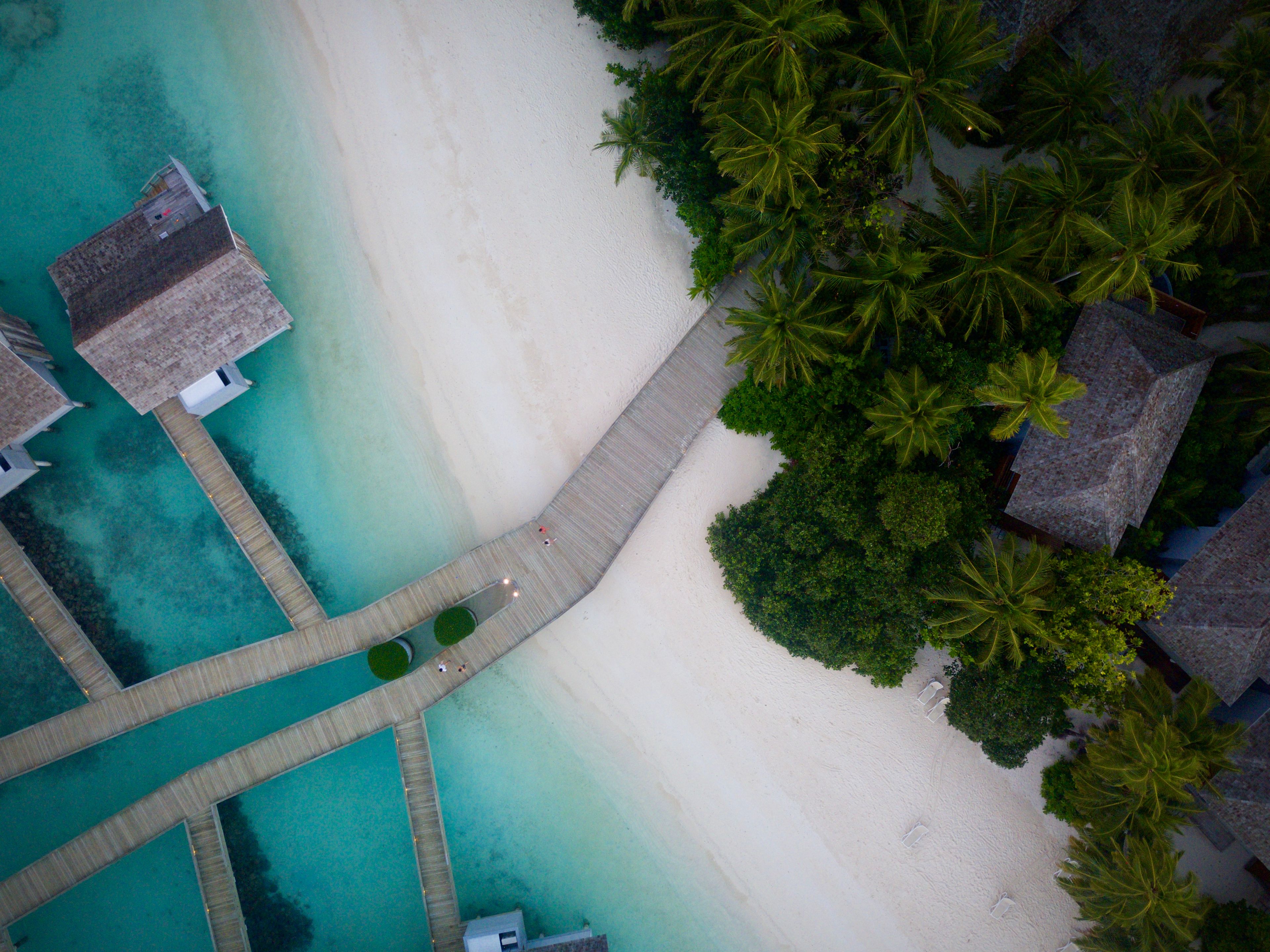
Maldives Luxury Travel Guide: Atolls, Transfers, Villas & Where to Stay
- Maldives
- Luxury
- Honeymoon
- Where to Stay
- Overwater Villas
A luxury Maldives travel guide for first-timers: how to choose your atoll, seaplane vs speedboat, beach vs overwater villas, costs, and where to stay.
Almost every "ultimate Maldives" article gets the order wrong. It opens with a wall of dreamy resort names and an infinity pool at sunset, as if the hard part were narrowing a shortlist. It isn't. The hard part is understanding that in the Maldives you don't book a hotel — you book a private island, and that one fact rewires the entire trip. This luxury Maldives travel guide exists to give you the orientation the glossy lists skip: before any resort matters, three structural decisions decide whether your honeymoon is effortless or a logistics scramble.
Here they are, in the order they actually matter: which atoll you base in, how you transfer from the airport (seaplane or speedboat), and which villa you sleep in (beach or overwater). Get those three right and the resort almost picks itself. Get them wrong — book a far-flung seaplane island on a flight that lands at 11pm, say — and your first "day in paradise" is spent in an airport hotel in Hulhumalé. So before a single villa photo, here's how to think about the Maldives like someone who's navigated Velana airport after dark and learned the daylight rule the expensive way.
The three decisions that define a Maldives trip
The Maldives is roughly 1,200 islands grouped into 26 natural atolls — rings of coral scattered across hundreds of kilometres of the Indian Ocean. A resort occupies one whole island; you fly into the single international airport at Velana (MLE), near the capital Malé, and then travel onward by boat or seaplane to your island. There is no "town" to wander into, no second hotel to switch to if you change your mind. You are committing to one island for the whole stay.
That structure is why these three calls dwarf everything else:
- Atoll — decides your transfer type, your cost to arrive, and which once-in-a-lifetime marine moment (mantas, whale sharks, pure seclusion) is on your doorstep.
- Transfer — seaplane or speedboat. This isn't a detail; it dictates how you book your international flights and whether a late arrival costs you a night.
- Villa — beach villa or overwater villa, the choice that shapes the daily texture of the trip and a big share of the bill.
Work them in that order. The rest of this guide takes each in turn at orientation depth, then points you to the deep-dive spokes that carry the real shortlists.
Decision 1 — Which atoll to base in
An atoll is the Maldivian equivalent of a neighbourhood, except the "neighbourhoods" are up to 90 minutes apart by boat and some can only be reached by floatplane. They genuinely differ — not in a marketing way, but in transfer reality and signature wildlife.
Short on deliberation? For a first luxury trip, base yourself in North Malé Atoll. It wraps around the airport, so most resorts are a speedboat of roughly 15 to 45 minutes — no second flight, no daylight-dependent seaplane, no lost night (LuxAtolls). It has romantic, design-led islands at every tier above budget, and you can be in your villa within an hour of clearing customs. The rest of this section is for deciding whether a different atoll fits your trip better — because for plenty of couples, one genuinely does.
A quick orientation to the atolls that matter most for a luxury stay:
- North & South Malé — the speedboat atolls. Closest to the airport, the widest spread of resorts, the lowest-stress arrival. North Malé is the classic first-timer base; South Malé adds world-class surf and anchors like the Waldorf Astoria and Mandarin Oriental (LuxAtolls).
- Baa — the manta atoll. A UNESCO Biosphere Reserve whose Hanifaru Bay hosts the largest known seasonal gathering of manta rays on earth (LuxAtolls). Seaplane access, roughly 30–40 minutes.
- North & South Ari — the diving and whale-shark atolls. South Ari is the whale-shark capital with year-round sightings; North Ari brings hammerheads and coral gardens (LuxAtolls). Seaplane, about 20–35 minutes.
- Noonu, Raa, Lhaviyani — the far-north seclusion atolls. Pristine, barely developed, home to some of the most exclusive resorts on earth — Soneva Jani, Cheval Blanc Randheli, JOALI (LuxAtolls). Longer seaplanes, around 35–45 minutes.
- The deep south (Gaafu, Addu) and Dhaalu — for repeat visitors chasing true remoteness. These usually mean a domestic flight (55–70 minutes) plus a speedboat, reaching Raffles, Park Hyatt Hadahaa or Shangri-La Villingili (LuxAtolls; ResortLife).
Atolls at a glance
The table below is built around the thing the vibe-only lists ignore — the transfer reality — because that, not the Instagram grid, is what will actually shape your trip. Signature resorts are named for orientation only; nightly tiers are relative bands within a destination where even "value" runs to honeymoon money, not literal price quotes.
| Atoll | Vibe / scene | Usual transfer (rough time) | Best for which traveler | Signature resort tier |
|---|---|---|---|---|
| North Malé | Easy, classic, low-stress | Speedboat, ~15–45 min | First-timers; late arrivals; tight schedules | Four Seasons Kuda Huraa, Gili Lankanfushi |
| South Malé | Surf + accessible luxury | Speedboat, ~30–60 min | Surfers; couples wanting a quick boat, not a plane | Waldorf Astoria, Mandarin Oriental |
| Baa | Wildlife wow + conservation | Seaplane, ~30–40 min | Manta-chasers; divers (seasonal) | Soneva Fushi, Four Seasons Landaa Giraavaru |
| South Ari | Year-round marine spectacle | Seaplane, ~25–35 min | Whale-shark dreamers; off-season weddings | Conrad Rangali, LUX* South Ari |
| North Ari | Established luxury + diving | Seaplane, ~20–25 min | Divers; design-led couples | Constance Halaveli, W Maldives |
| Noonu | Ultra-secluded showpiece | Seaplane, ~40–45 min | Privacy + design above all; milestone splurge | Soneva Jani, Cheval Blanc Randheli |
| Raa | Pristine, fresh, exclusive | Seaplane, ~40 min | Seclusion-seekers; adults-only fans | JOALI, InterContinental Maamunagau |
| Deep south (Gaafu / Addu) | True remoteness | Domestic flight 55–70 min + boat | Repeat visitors; "end of the earth" splurge | Raffles, Park Hyatt, Shangri-La Villingili |
For the full atoll-by-atoll breakdown of where to actually sleep, see where to stay in the Maldives for a honeymoon, and once you're comparing the resorts themselves, our roundup of the best Maldives resorts for a luxury honeymoon picks up where this leaves off.
Decision 2 — Seaplane, speedboat, or domestic flight
This is the decision most first-timers underestimate, and the one most likely to bite. Your transfer type is set by your atoll, and it changes how you book your flights home and out — so settle it before you reserve anything.
Speedboat is the low-stress option. Resorts near the airport — almost all of North and South Malé — run private speedboats that operate around the clock, so a late-night landing is no problem; you board and go (Maldives Magazine). Times run roughly 15 to 90 minutes depending on distance, and the cost is the gentlest of the three at about $150–$400 return per adult (ResortLife).
Seaplane is the jaw-dropping option — a Twin Otter floatplane skimming over turquoise atolls, easily a trip highlight in itself. It's also the one with the catch. Seaplanes fly daylight only, roughly 06:00 to 16:00, because they operate under visual flight rules (Maldives.com). They cost more — about $450–$800 return per adult (ResortLife) — and the luggage allowance is tighter than your international flight's, typically around 20kg checked plus 5kg hand luggage, with excess charged per kilo (Maldives.com).
Domestic flight plus speedboat serves the far north and deep south — Gaafu, Addu, Laamu and similar — where a seaplane is impractical. Budget a domestic hop of roughly 50–70 minutes plus a 15–45 minute boat, at about $450–$700 return per adult, usually bundled into the resort package (ResortLife).
The daylight trap — and why a Malé overnight happens
Here is the single most useful thing in this guide. If your atoll needs a seaplane and your international flight lands late, you cannot fly to your resort that day. The seaplane doesn't fly after dark. The practical rule operators give is to land in Malé by around 15:00 for a same-day connection — ideally before 15:30 — because the last resort-bound floatplanes leave around 15:30–16:00 (Maldives.com; ResortLife).
Land later than that and your resort or travel provider will put you up in a hotel in Malé or Hulhumalé, near the airport, and fly you out on the first seaplane next morning (Maldives.com). It's not a disaster — but it's a night of your honeymoon spent by the airport instead of over a lagoon, plus an extra hotel cost nobody budgeted for. Two ways to avoid it: choose a flight that lands before mid-afternoon, or pick a speedboat atoll, where a midnight arrival just means a midnight boat. We weigh the full cost-time-daylight trade-off in seaplane vs speedboat for luxury Maldives resorts.
Decision 3 — Beach villa or overwater villa
Once your atoll and transfer are settled, the villa is the last big call — and it's more than aesthetics. The two archetypes are different trips.
The overwater villa is the postcard: a teak deck over a glass-clear lagoon, a ladder straight into the water, sunrise (or sunset, if you pick your side) from the bed. It is the Maldives most people are picturing. The honest trade-offs: it's the pricier villa category, the "beach" is a swim or a walk away, and on a windy day the water below your deck can be choppy rather than mirror-calm.
The beach villa puts you on the sand with a private stretch of beach, often a plunge pool, and direct barefoot access to the shore — frequently more space for the money, and better for anyone wary of a long drop to deep water. The trade-off is that you're not over the lagoon; you look at it from the sand rather than your deck.
My steer for a first luxury trip and especially a honeymoon: split the stay if the resort allows it — a few nights in a beach villa to settle in, then finish in an overwater villa for the showpiece moment. If you must choose one, overwater wins for the once-in-a-lifetime honeymoon; beach wins for value, space and families. The one combination to think twice about is an overwater villa for a whole long stay with young kids — the open-water deck is a constant supervision job.
We go property-by-property on the overwater question, including which lagoons stay calmest and which villas have private pools, in the best Maldives overwater pool villas.
What it actually costs (in bands, not quotes)
The Maldives confuses first-timers on price because the headline rate is rarely what you pay. Three things stack on top, and understanding them is worth more than any "cheapest month" hack.
1. The villa rate. For the luxury tier, overwater villas broadly run entry-level around $260–$500 a night, a wide mid-band roughly $500–$1,000, and the showpiece/ultra-luxury tier from $1,000 well into the thousands — the most extravagant reserves at properties like Soneva Jani reach into five figures a night (LuxAtolls). Resort-wide, a useful mental band for a 5-star stay is roughly $400–$3,300+ a night before extras (Maldives.com). Treat these as orientation, not quotes — price your actual dates.
2. The "++" — tax and service. This is the one that surprises people. Maldives resorts quote rates with "++" meaning plus tax, plus service, and the law adds a 17% Tourism GST and a 10% service charge on top of the room and almost everything you spend on-island — food, drinks, spa, excursions (IM Maldives; Travel Trade Maldives). That's roughly 27% added to the base. A villa listed at "$600++" is closer to $760 a night before anything else. On top of that sits a flat Green Tax of about $12 per person, per night at resorts (it doubled from $6 in January 2025) (IM Maldives; Travel Trade Maldives). Across a week for two, the taxes and service alone routinely add several hundred to over a thousand dollars to the headline (IM Maldives).
3. The transfer. Add the round-trip transfer per adult from Decision 2 — roughly $150–$400 by speedboat, $450–$800 by seaplane, $450–$700 by domestic flight plus boat (ResortLife). For a couple, a seaplane atoll can quietly add the better part of $1,000–$1,600 before you've touched the minibar.
Where all-inclusive changes the math. Because GST and service hit every item, a Maldives island is brutally à-la-carte: a la carte dinners, a $7 coffee, a snorkel trip — each carries the 27%. On a long stay, or anywhere remote where there's no alternative to the resort's own restaurants, a genuine luxury all-inclusive (or at least half-board) plan can be the saner choice, because it caps the death-by-extras spiral that catches room-only bookers. We lay out where it pays off in the best time to visit the Maldives for a luxury honeymoon, alongside the seasonal rate swings below.
Best time to go (the short version)
Season is effectively a pricing lever. The dry season, roughly December to April, brings the calmest seas, lowest humidity and clearest skies — and the highest rates, peaking around the festive weeks. The low/green season, roughly May to October, is wetter and windier in bursts but can run 30–50% cheaper on villa rates (LuxAtolls) — and it's also manta and whale-shark season, so the "worse" weather window is when the headline marine encounters peak.
My verdict for the luxury traveler: the shoulder edges — late April–May and late October–November — are the sweet spot, threading calmer-than-monsoon weather with off-peak pricing. Only commit to the December–February peak if a specific date (a New Year's villa, a milestone) is the whole point, and book it many months out. The full month-by-month breakdown lives in our seasonal guide.
Where to stay + which villa: putting it together
You now have the framework. The booking sequence that follows from it:
- Pick the atoll by vibe and the marine moment you want — then accept its transfer.
- Choose the transfer-compatible flight. If it's a seaplane atoll, land in Malé by mid-afternoon or knowingly accept a Malé overnight.
- Choose the villa — overwater for the showpiece, beach for space and value, or split the stay.
- Decide the meal plan — lean all-inclusive/half-board the more remote you go or the longer you stay.
Use the map below to compare what's genuinely available across the main resort atolls on your exact dates — it spans the booking sites in one view, so you can sanity-check real rates against the bands above before you commit. The deep picks — specific resorts, specific villas — live on the spokes.
For the next layer down, our atoll-by-vibe guide to where to stay in the Maldives for a honeymoon turns this framework into a base, and the best luxury honeymoon resorts and best overwater pool villas turn the base into a booking.
How to decide, by what matters most to you
- Want the easiest, lowest-stress trip? North Malé — a speedboat, no seaplane logistics, romantic at every tier.
- Dreaming of mantas? Baa — but the spectacle is seasonal, roughly May to November.
- Marrying off-season and still want a marine wow? South Ari, for year-round whale sharks.
- Privacy and a showpiece villa above all? Noonu or Raa — accept the longer seaplane and the price.
- The overwater postcard is non-negotiable? Choose an overwater villa, ideally on a sheltered lagoon, and consider splitting with a beach villa.
- Value and space, or travelling with kids? A beach villa, on a speedboat atoll, on a half-board or all-inclusive plan.
- Best weather-to-price balance? The shoulder edges — late April–May or late October–November.
Whichever way you lean, the rule holds: settle the atoll, the transfer and the villa before you fall for a room photo. Do that — and get the daylight maths right — and you've solved the only genuinely hard part of a Maldives trip. The rest really is just choosing which shade of turquoise to wake up to.
FAQ
How do you actually get to a Maldives resort from the airport? By private speedboat, seaplane, or a domestic flight plus a speedboat — and which one is fixed by your resort's atoll, not by you. North and South Malé resorts use speedboats (roughly 15–90 minutes, running day or night). Further atolls like Baa, the Aris, Noonu and Raa use seaplanes (about 25–45 minutes, daylight only). The far north and deep south use a domestic flight plus a boat. Settle this before booking your international flights (ResortLife).
Why might I have to overnight in Malé before reaching my resort? Because seaplanes only fly in daylight, roughly 06:00 to 16:00. If your international flight lands too late — generally after about 15:00 — you can't connect to a same-day seaplane and will stay in a Malé or Hulhumalé hotel near the airport, flying out next morning (Maldives.com). Speedboat atolls have no such constraint, which is why they're the low-stress choice for late arrivals.
What does "++" mean on a Maldives resort price? It means plus tax, plus service — the quoted rate excludes the 17% Tourism GST and 10% service charge that Maldives law adds to your room and on-island spending, about 27% on the base (IM Maldives). A separate flat Green Tax of about $12 per person per night also applies at resorts (Travel Trade Maldives). So a "$600++" villa is roughly $760 before green tax and extras — budget for it.
Should I book an overwater villa or a beach villa? Overwater for the once-in-a-lifetime postcard moment (it's pricier, and the beach is a short walk); beach for more space per dollar, a private stretch of sand, and easier access with kids. If the resort allows it, split your stay — beach first, overwater to finish. We compare the overwater options in detail in our overwater villa guide.
Is a Maldives trip cheaper if I book all-inclusive? Often, yes — and not for the reason people think. Because the 27% tax-and-service hits every item (every dinner, drink, coffee and excursion), a room-only booking on a remote island where the resort is the only option can spiral. A genuine luxury all-inclusive or half-board plan caps that, which makes it the saner choice the more remote you go or the longer you stay. Speedboat atolls near Malé give you more flexibility to dial it down.
When is the best time to visit the Maldives? December to April for the calmest, driest weather — but it's peak pricing. May to October is wetter but 30–50% cheaper and is manta/whale-shark season (LuxAtolls). For the best balance, target the shoulder edges — late April–May or late October–November. See our seasonal guide for the month-by-month detail.
Ready to plan?
Work the three decisions in order — atoll, transfer, villa — and the hardest part of a Maldives trip is already behind you. Pin your atoll by the marine moment and the seclusion you want, book a flight that respects the seaplane daylight rule (or sidestep it with a speedboat atoll), choose your villa, and lean all-inclusive the more remote you go. Use the map above to compare live rates across the atolls for your exact dates, then follow the spokes — starting with where to stay for a honeymoon — to turn this framework into a booking.
Sources
- LuxAtolls — Maldives Atolls Guide (transfer types & times, atoll character, signature resorts): luxatolls.com
- LuxAtolls — Maldives Overwater Bungalows & Villas 2026, prices & tiers (price bands, low-season discount): luxatolls.com
- Maldives.com — Travelling by Seaplane in the Maldives (daylight-only hours, 15:00 arrival rule, baggage, Malé overnight): maldives.com
- ResortLife — Maldives Transfers 2026: Seaplane vs Speedboat vs Domestic Flights (cost bands, transfer times, late-arrival rule): resortlife.travel
- IM Maldives — Maldives Resort Taxes 2026: GST, Green Tax & Service Charge (17% GST, 10% service, $12 green tax, "++" worked example): immaldives.com
- Travel Trade Maldives — Maldives Increases Tourism Taxes, TGST to 17% (rate change effective July 2025, green tax doubling): traveltrademaldives.com
- Maldives Magazine — Speedboat vs Seaplane, North Malé transfer access (round-the-clock speedboats): maldives-magazine.com