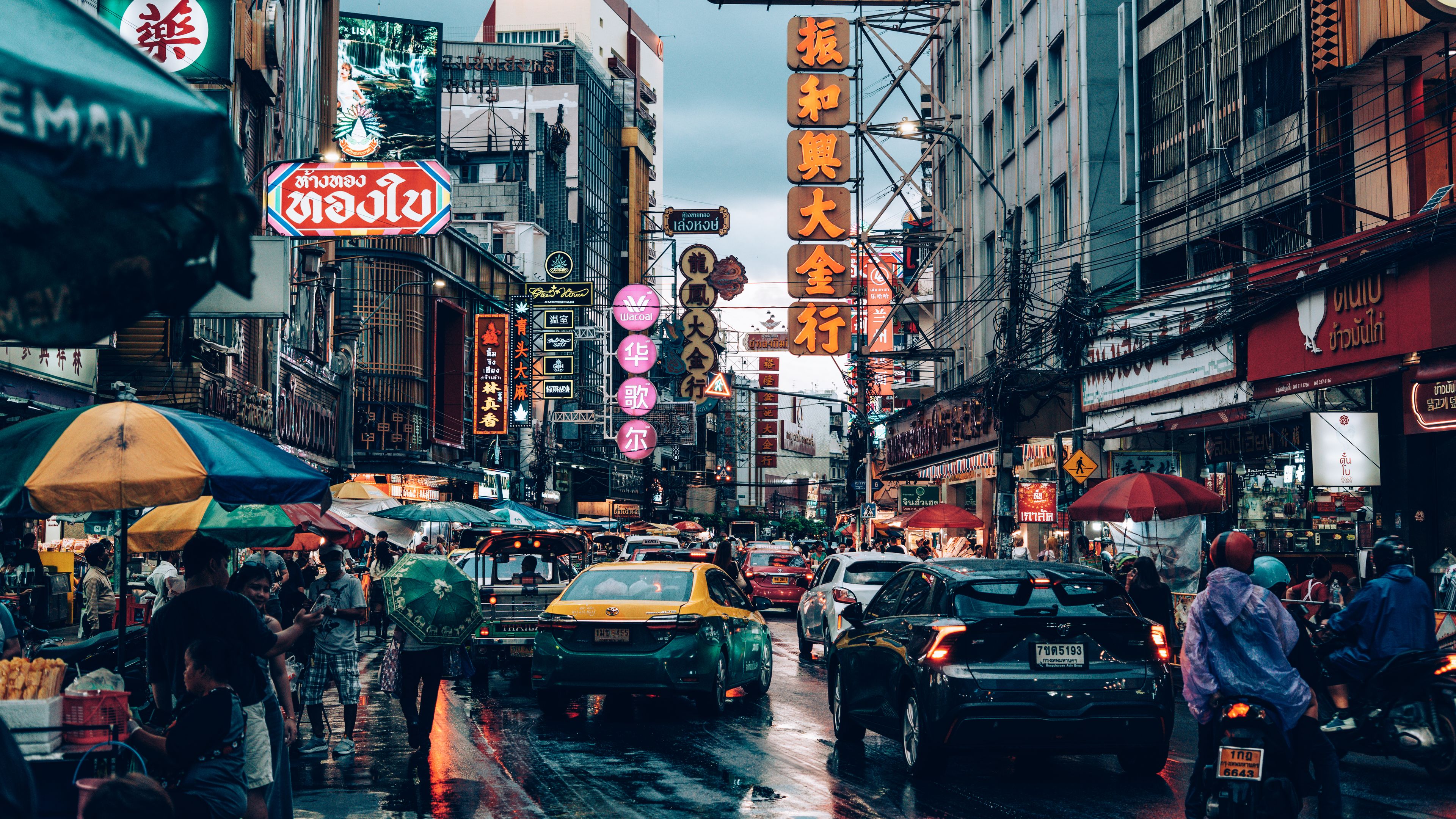
Chiang Mai vs Bangkok for Digital Nomads: Which Thai Base Wins for a Long Stay?
- Chiang Mai
- Bangkok
- Thailand
- Digital Nomad
- Cost of Living
Chiang Mai vs Bangkok for digital nomads: monthly cost, internet, community, transport and air quality compared, with a clear verdict by nomad type.
For a two-week holiday, Chiang Mai vs Bangkok for digital nomads is barely a question — you'd do both, an hour's flight apart. For a 30-plus-day working stay it's the call that sets your rent, your daily commute, your community and whether your 3pm video call rides on fast fiber or fights a thunderstorm. The two cities get lumped together as "Thailand," but for someone living and working there they pull in opposite directions: one is the cheap, tight-knit, heads-down productivity capital; the other is the big-city machine with the infrastructure, the transport, the hospitals and the networking. This is a long-stay head-to-head, not a sightseeing one.
So here's the verdict this guide defends, instead of the usual "both are amazing" shrug. Base in Chiang Mai if you want the lowest monthly burn, the deepest ready-made nomad community and a calm, focused base — and you'll accept a smaller city, a scooter instead of a metro, and a brutal burning season you plan around. Base in Bangkok if you want top-end internet, a real metro, world-class healthcare, bigger business networking and constant flights — and you'll pay more, commute further and live louder. The rest of this post scores that out, criterion by criterion, on the six things that actually decide a working month — then gives a verdict by nomad type. One honesty note up front that the tourist comparisons skip: both cities have a dry-season air problem, and I'll be straight about it.
The nomad criteria I'm scoring on
A comparison is only honest if you name what you're measuring before you crown a winner. For someone here a month or more with a laptop, six things decide it:
- Monthly cost — what a comfortable working month actually runs, rent included.
- Internet & infrastructure — fiber speed, reliability, and the bones of the city around it.
- Community — how easy it is to plug into other nomads, and what flavor of community it is.
- Getting around — metro vs scooter, and the daily time tax of moving across town.
- Air quality & seasonality — the dry-season smoke reality for both, and when to come.
- Lifestyle & vibe — what living there actually feels like day to day.
Here's how each shakes out, then the table, then the verdict by nomad type.
Monthly cost — edge: Chiang Mai, decisively
This is the row Chiang Mai wins outright, and for a lot of nomads it's the row that ends the argument.
Chiang Mai is routinely ranked the most affordable nomad city on earth — a February 2026 study of 28 destinations put it first, with remote workers spending "less than $1,000 on rent and living costs," and ranked Bangkok second at around $1,200 a month (with more coworking than Chiang Mai) (ScandAsia). The direction is consistent across sources: one 2026 head-to-head pegs a comfortable Chiang Mai month at roughly $1,000–1,500 against Bangkok's $1,500–2,500, with Bangkok running about 40–60% higher for the same comfort level (Silicon Valley Time). Nomad List's running estimates land in the same place — a typical Chiang Mai nomad around $1,190 a month, Bangkok higher (Nomad List — Chiang Mai; Nomad List — Bangkok).
The gap is mostly rent. In Chiang Mai, a furnished one-bedroom runs roughly $400–800 a month (and $300–450 on the outskirts); in Bangkok the equivalent is $600–1,200, and total cost of living lands around $720–1,460 in Chiang Mai versus $1,000–2,200 in Bangkok (Travel Arbitrage). A central Bangkok studio in Sukhumvit or Sathorn is 20,000–40,000 THB a month, dropping to 12,000–20,000 THB in outer areas like On Nut (That Bangkok Life) — so you can approach Chiang Mai numbers in Bangkok, but only by living on the fringe and commuting in. Food and transport are cheap in both (Bangkok street meals run 40–80 THB, a monthly BTS pass roughly 1,000–2,000 THB (That Bangkok Life; City Cost — Bangkok)), but Chiang Mai's street-food-and-scooter life is cheaper still.
Edge: Chiang Mai. If "make my runway last" is the brief, this is your city — the full monthly breakdown is in our Chiang Mai cost-of-living guide.
Internet & infrastructure — edge: Bangkok (but Chiang Mai is genuinely fine)
Here's where the big city earns its premium, though the gap is narrower than nervous first-timers fear.
Both cities are fast. Across head-to-heads, average download speeds in Chiang Mai and Bangkok "often exceed 300–600 Mbps, with many coworking spaces offering dedicated fiber lines up to 1 Gbps" (Silicon Valley Time). Chiang Mai's measured average sits around 184 Mbps down / 68 Mbps up as of early 2026, with most modern condos shipping 300–500 Mbps fiber as standard and hard outages rare (My Nomad Space). For everything short of huge uploads, Chiang Mai's Nimman and Old City fiber is more than enough for calls.
Bangkok's edge is at the top end and on consistency. Fixed broadband averages above 200 Mbps, modern condos deliver 300 Mbps to 1 Gbps, and the area-by-area data is eye-watering — 500 Mbps–1 Gbps symmetrical in Silom/Sathorn, 620 Mbps down / 580 up at a sample Ari condo, a full 1 Gbps in the Rama 9 corridor — with near-zero broadband outages over multi-month stays and strong central 5G (Superagent — Bangkok internet by area; Digital Nomad Lifestyle — Bangkok). The honest caveats cut both ways: Chiang Mai's rainy season (roughly June–October) brings the occasional outage (Travel Arbitrage), and in Bangkok older condos still cap at 50–100 Mbps on VDSL, so confirm fiber to the actual unit before you sign (Superagent — Bangkok internet by area).
The wider infrastructure is where Bangkok pulls clearly ahead. It has a true metro, an international-flight hub at two airports, and world-class private healthcare — Bumrungrad and Samitivej rank among the best private hospitals anywhere (Bangkok Heaven). Chiang Mai's hospitals are good; Bangkok's are a genuine medical-tourism destination. Edge: Bangkok — but if your week is normal calls and deep work rather than 4K uploads or a standing medical need, Chiang Mai clears the bar. Whichever you pick, the rule is identical: never run a video-call workday on a single untested connection — grab an AIS, TrueMove or dtac SIM as a tethering backup (My Nomad Space).
Community — edge: Chiang Mai for nomads, Bangkok for business networking
This row splits by what kind of people you want around you, so the "winner" depends on why you network.
Chiang Mai wins the dedicated-nomad community, and it's not close. It's been the spiritual home of the Asia nomad scene for over a decade — a tight, productivity-oriented crowd of thousands of remote workers, with a meetup, mastermind or skill-share happening most days, and a coworking ecosystem (Hub53, Yellow, Punspace, Alt_ChiangMai) built around laptops rather than laptops being tolerated (Silicon Valley Time; My Nomad Space). The whole culture is oriented around shipping work and living cheaply, so the community you plug into is overwhelmingly other independent nomads and bootstrappers. If you want a ready-made friend group and your people handed to you in week one, Chiang Mai is the easiest landing anywhere in Asia.
Bangkok wins business networking and scale. Its scene is bigger and more varied — an active nomad-and-expat circuit with weekly meetups and social events (Digital Nomad Lifestyle — Bangkok) — but it's also plugged into a real economy of startups, agencies, corporates and a far larger expat-professional population. The coworking roster reflects that: The Hive Thonglor and Hubba for the creative-social crowd, JustCo for the polished corporate end, and True Digital Park in Punnawithi as a massive tech hub (Bangkok Heaven). The networking here is "unparalleled" specifically if you're after clients, partners, investors or industry contacts rather than fellow location-independent freelancers (Bangkok Heaven). Edge: Chiang Mai for the nomad tribe; Bangkok if your networking is business-led.
Getting around — edge: depends what you value, and they're genuine opposites
This is the cleanest split in the whole comparison, and it surprises people.
Bangkok has the metro; Chiang Mai doesn't. Bangkok's BTS Skytrain, MRT subway, Airport Rail Link, Grab and even canal boats mean you can live entirely car-free and scooter-free (Digital Nomad Lifestyle — Bangkok) — a real quality-of-life and safety win if you don't want to ride two wheels in Southeast Asian traffic. Chiang Mai has no metro at all: outside walkable Nimman and the Old City, daily life runs on a rented scooter (about $80–150 a month) plus Grab for the rest (Travel Arbitrage).
But "Bangkok has transit" doesn't mean Bangkok is faster to live in — the opposite, in fact. Bangkok's average daily commute is about 96 minutes, against Chiang Mai's roughly 25 (Travel Arbitrage). Bangkok is vast and clogged; even with a great metro, getting across it eats your day, and anywhere off the BTS/MRT lines means a sweaty Grab through gridlock. Chiang Mai is small enough that your café, coworking, gym and dinner can all sit within a ten-minute scooter loop. So the honest framing: Bangkok wins if you refuse to ride a scooter (the metro is the escape), Chiang Mai wins if you value a short commute and a compact daily life — just budget for two wheels. As the cleanest summary of the whole trade-off I found puts it: "Bangkok gives more options; Chiang Mai gives more time" (Travel Arbitrage).
Air quality & seasonality — the shared problem nobody markets
Here's the row the glossy "Thailand for nomads" pieces quietly omit: both cities have a dry-season air-pollution problem. Neither gets a clean pass, and pretending otherwise is how nomads end up booking the worst possible month.
Chiang Mai's is more extreme — the burning season. From roughly February through April, agricultural burning across northern Thailand, Laos and Myanmar fills the mountain basin with smoke, and with no wind or rain it just sits there (cnxlocal). In the worst weeks of late February and March the AQI routinely passes 300; 2026 was brutal, with Chiang Mai ranked the single most polluted city on Earth on March 30 (AQI 233, PM2.5 at 188 µg/m³) and the city declared a disaster zone on April 4 (Open Magazine; IQAir — Chiang Mai burning season). The rains around mid-April clear it (cnxlocal). This is a non-negotiable for long-stayers — and the whole community's playbook is the same: come November to January, then decamp to the southern islands (Koh Lanta, Phuket, Krabi) for March and April.
Bangkok's is milder but real — and on a similar dry-season clock. Bangkok's pollution peaks across the dry months too, worst around January to March from traffic, construction, factories and the same cross-border farm smoke, settling in under temperature inversions (IQAir — Bangkok). It doesn't reach Chiang Mai's apocalyptic numbers, but it's not trivial: in 2026 only about 27% of days met WHO's safe air-quality limit — meaning roughly 73% exceeded it — with January the worst month, and June the cleanest once the rains arrive (AQI.in — Bangkok historical analysis). Historically Bangkok's annual PM2.5 average has run around 22.8 µg/m³, well above the WHO guideline, spiking to roughly 47 µg/m³ in a bad January (IQAir — Bangkok).
So the honest read: the cool, clear window (roughly November–January) is the best time to be in either city, and the dry-season tail (Feb–April) is the one to plan around in both — far more dramatically in Chiang Mai. Neither is a year-round clean-air base. Edge: Bangkok on raw severity (its smoke is bad, not catastrophic), but both reward the same calendar discipline. Chiang Mai's full timing playbook is in our best areas guide, which factors the seasons into where you base.
Lifestyle & vibe — edge: a tie (they're different lives)
This one's a genuine wash, because the two offer completely different versions of a good month and neither is better in the abstract.
Chiang Mai is calm, green, cheap and focused. It's a relaxed northern city ringed by mountains and temples, with brilliant cafés, a slow pace and a culture built around productivity and value rather than partying (Silicon Valley Time). The trade-off is that it's small and landlocked — no beach, a modest nightlife, and the same faces after a few months. Bangkok is big-city electricity: world-class food at every price point, rooftop bars, malls, a serious nightlife, endless neighborhoods to explore, and the buzz (and noise, heat and crowds) of a 10-million-person capital. The trade-off is exactly that intensity — it can be exhausting, and it costs more to live well. Chiang Mai is where you go to focus and save; Bangkok is where you go to live large and stay plugged in. Tie — pick your speed.
Chiang Mai vs Bangkok for digital nomads: the head-to-head table
| Criterion | Chiang Mai | Bangkok | Edge |
|---|---|---|---|
| Monthly cost | ~$1,000–1,500 comfortable; 1BR $400–800; cheapest nomad city | ~$1,500–2,500; 1BR $600–1,200; ~40–60% pricier | Chiang Mai |
| Internet & infrastructure | Avg ~184 Mbps; condos 300–500 Mbps; fine for calls | Condos 300 Mbps–1 Gbps; rare outages; metro, airports, top hospitals | Bangkok |
| Community | Deepest dedicated-nomad scene in Asia; daily meetups | Bigger, business-led networking; startups/expats/corporates | Split (nomad vs business) |
| Getting around | No metro; scooter + Grab; ~25-min commute | BTS/MRT, car-free possible; but ~96-min commute, vast & clogged | Split (scooter vs metro) |
| Air quality & seasonality | Catastrophic burning season Feb–Apr (AQI 300+); clean Nov–Jan | Milder but real; worst Jan–Mar (~73% of days over WHO 2026) | Bangkok (less severe) |
| Lifestyle & vibe | Calm, green, cheap, focused; small, no beach | Big-city energy, food, nightlife; intense, pricier | Tie |
Read that honestly and Chiang Mai takes the two rows most independent nomads care about — cost and community — while Bangkok takes infrastructure and edges air-quality severity, and the other two rows split or tie. So the verdict isn't "Chiang Mai, end of story." It's "Chiang Mai for the cheap, focused, plugged-in nomad life; Bangkok if you specifically need the metro, the hospitals, the business networking or the big-city buzz, and you'll pay for them."
So which should YOU base in? Verdict by nomad type
The criteria crown Chiang Mai on cost and community and Bangkok on infrastructure. But "best on average" isn't "best for you." Here's the call by nomad type.
Budget builder / bootstrapper → Chiang Mai
If your goal is to stretch a small runway while you build something, this is the obvious pick. Chiang Mai is the cheapest major nomad city anywhere, the community is full of other people doing exactly the same thing, and the low burn plus focused culture is purpose-built for shipping (ScandAsia). The honest trade-off you're signing up for: a smaller city, a scooter, and the burning season. Plan the year around the smoke and it's hard to beat on cost-per-quality-of-life.
First Asia trip → Chiang Mai
For a first time in Asia, Chiang Mai is the gentlest on-ramp: cheap enough that mistakes don't hurt, small enough not to overwhelm, and stuffed with other nomads who'll show you the ropes within days. Bangkok as a first base is a lot at once — vast, hot, intense, and harder to find your feet in. Start in Chiang Mai, then graduate to Bangkok once you've got your systems down.
Networker / business-led → Bangkok
If you're chasing clients, partners, investors or an actual industry scene rather than a freelancer friend-group, Bangkok wins. It has the startups, the agencies, the corporate coworking (JustCo, True Digital Park) and the sheer professional density that Chiang Mai's bootstrapper community can't match (Bangkok Heaven). Add the best healthcare in the region and the constant international flights, and Bangkok is the base that connects you to the wider world.
Family / long-haul stayer → Bangkok (mostly)
For families and very long stays, Bangkok's infrastructure starts to outweigh Chiang Mai's price: international schools, world-class hospitals (Bumrungrad, Samitivej), a metro the kids can use, and endless indoor options for the hot and smoky months (Bangkok Heaven). Chiang Mai is the calmer, cheaper family base if you'll run a scooter and leave for burning season — but if a standing medical need or schooling is in play, Bangkok's depth wins.
Beach-adjacent nomad → neither, but Chiang Mai is the better launchpad
Be clear-eyed: neither is a beach base. Both are inland (Chiang Mai in the mountains, Bangkok 90 minutes from the muddy Gulf). If sand and surf are core to your trip, you want the islands or Bali, not either of these cities. But of the two, Chiang Mai is the better launchpad for the standard play — base cheap in the cool season, then ride the burning-season exodus down to Koh Lanta, Phuket or Krabi for March and April. If beach-and-surf nomad life is genuinely the priority, weigh Thailand against the islands in our Chiang Mai vs Bali comparison.
The bottom line
For most independent nomads it's Chiang Mai — the lowest burn of any major base, the deepest ready-made community in Asia, and a calm city built for shipping work, as long as you'll wear the scooter, the smaller scene and a burning season you schedule around. Go Bangkok when you genuinely need the infrastructure of a real metropolis — top-end fiber, a metro, world-class hospitals, business networking and endless flights — and you'll trade up in cost, commute and noise to get it. The caveat the tourist comparisons skip applies either way: both share a dry-season air problem, so land in the cool, clear November-to-January window and plan around the February-to-April smoke — drastically so in Chiang Mai.
Decide which of those nomads is you — cheap-and-focused or big-city-and-connected — then sort the base. It's a slow decision you'll book later, so there's no rush tonight; but the good monthly-friendly stays in both go first in the cool-season peak, so it's worth scanning live rates for your actual dates before you commit.
Check live rates for monthly-friendly Chiang Mai stays on Expedia for your dates →If the verdict points you to Chiang Mai — as it does for most independent nomads — the next step is choosing your neighborhood and your kind of stay. Start with our Chiang Mai digital nomad guide for the full long-stay framework, then go deep on the best areas to base in and model your budget with the cost-of-living breakdown.
FAQ
Is Bangkok more expensive than Chiang Mai for a nomad? Yes, consistently. A comfortable Chiang Mai month runs about $1,000–1,500 against Bangkok's $1,500–2,500, roughly 40–60% higher for the same comfort (Silicon Valley Time). The gap is mostly rent: a furnished one-bed is about $400–800 in Chiang Mai versus $600–1,200 in Bangkok (Travel Arbitrage). You can hit Chiang Mai-like prices in Bangkok only by living on the fringe and commuting in.
Does Bangkok have a burning-season air problem like Chiang Mai? Both have a dry-season air problem; Chiang Mai's is far worse. Chiang Mai's burning season (Feb–April) can push the AQI past 300, and it was declared a disaster zone in 2026 (Open Magazine). Bangkok's pollution is milder but real, peaking January–March — in 2026 only about 27% of days met WHO's safe limit (AQI.in — Bangkok historical analysis). The cool, clear November–January window is best for both.
Can I just split my time between Chiang Mai and Bangkok? Plenty of nomads do — they're an hour's flight apart, and Thailand's DTV long-stay visa makes a multi-month stay straightforward (see the visa section of our Chiang Mai nomad guide). A common shape is Chiang Mai in the cool season for the cheap, focused base, with Bangkok stints for healthcare, networking, flights or a big-city reset — then both cities cleared out for the worst of the spring smoke.
Sources
- ScandAsia — Chiang Mai named world's cheapest city for digital nomads (Feb 2026 ranking, Bangkok 2nd ~$1,200): scandasia.com
- Silicon Valley Time — Ultimate Thailand Digital Nomad Guide 2026 (CM vs BKK cost bands, internet, community, verdict): siliconvalleytime.com
- Travel Arbitrage — Bangkok vs Chiang Mai cost comparison for digital nomads 2026 (rent, total cost, commute times, internet): travelarbitrage.net
- Nomad List — Cost of Living in Chiang Mai (running monthly estimate): nomads.com
- Nomad List — Cost of Living in Bangkok (running monthly estimate): nomads.com
- That Bangkok Life — Cost of Living in Bangkok 2026 (rent by area in THB, food, BTS pass): thatbangkoklife.com
- City Cost — Cost of Living in Bangkok 2026 (one-bed rent, BTS/MRT, totals): citycost.org
- My Nomad Space — Internet in Chiang Mai: Speed, Reliability & Wi-Fi for Remote Work (Mbps averages, condo fiber, SIM backup): mynomadspace.com
- Superagent — Internet Speed in Bangkok by Area (condo/coworking fiber Mbps, VDSL caveat): superagent.co
- Digital Nomad Lifestyle — Bangkok Digital Nomad Guide 2026 (tested café Wi-Fi speeds, reliability, transport, cost): digitalnomadlifestyle.com
- Bangkok Heaven — Bangkok Digital Nomad Guide 2026 (coworking, networking, healthcare, cost): bangkokheaven.com
- cnxlocal — Chiang Mai Burning Season 2026: Dates, Air Quality & What to Do (months, AQI, escapes): cnxlocal.com
- Open Magazine — Chiang Mai Chokes: Inside Thailand's Worst Air Crisis of 2026 (AQI 233, PM2.5 188, disaster zone): openthemagazine.com
- IQAir — Chiang Mai Ranks Among the Top 10 Most Polluted Cities During Thailand's Burning Season (March 2026): iqair.com
- IQAir — Bangkok Air Quality (annual PM2.5 average, January peak, WHO comparison): iqair.com
- AQI.in — Bangkok Historical Air Quality Analysis (2026 monthly pattern, % of days over WHO): aqi.in