
3 Days in Amsterdam: A Mid-Range Itinerary (Where to Base Yourself & What to Skip)
- Amsterdam
- Netherlands
- Itinerary
- Mid-Range
- City Break
A realistic 3 days in Amsterdam itinerary for mid-range travelers: what to do each day by area, what to skip, and where to base yourself to walk most of it.
The good news about a 3 days in Amsterdam itinerary: the city is small, flat, and so walkable that the whole canal ring fits inside a long stroll. The catch is that the two things everyone flies in for — the Anne Frank House and the Van Gogh Museum — now sell timed tickets weeks ahead, so a "we'll wing it" trip quietly turns into a "sold out, sorry" trip. Three days is genuinely enough to do Amsterdam well on a mid budget if you group the city by area each day so you barely touch a tram, pre-book the two things that sell out, and skip the tourist tax dressed up as attractions along Damrak.
This is that plan: a walkable, day-by-day route grouped by neighborhood, with honest "worth it vs skip" calls on the expensive stuff and one clear recommendation on where to base yourself so every morning starts on foot.
Where to base yourself: the Canal Belt, so all three days start on foot
Pick your base before your hotel, and pick it for location per euro, not for a slightly nicer room two tram stops out. For this itinerary the answer is the Canal Belt (Grachtengordel) — ideally the Nine Streets (De Negen Straatjes) pocket between the canals. Here's the logic, and it's geographic, not vibes: the Canal Belt sits dead-center between the two halves of this whole plan. The Jordaan and the Anne Frank House are a 5–10 minute walk west; Dam Square and the old center are a few minutes east; and the museums on Museumplein are a flat 15–20 minute walk (or one short tram) south. Base here and you walk to almost everything in this guide.
The Canal Belt is the postcard Amsterdam — Singel, Herengracht, Keizersgracht and Prinsengracht, a UNESCO-protected ring of 17th-century canal houses that's been "virtually unchanged for over 400 years," and it reads as more elegant and low-key than the busier Centrum right next to it (GetYourGuide). The Nine Streets — the little cross-streets linking the canals — are full of boutiques, cafés and design hotels, which is exactly the kind of characterful 3-4 star stock a mid-range traveler wants (GetYourGuide).
The honest trade-off: central-canal addresses run pricier than the same comfort further out, and the prettiest Jordaan-side stays carry a small premium on top (Headout). For most travelers that premium buys back the thing three days can't spare — commuting time. One real watch-out on price: Amsterdam's tourist tax is 12.5% of the room rate in 2026 and is usually not shown in the advertised nightly price, so a €200 room actually rings up around €225 (Amsterdam Tourism). Budget for it. Mid-range here generally means roughly €150–250 a night for a central 3-4 star outside deep winter, climbing hard in the July–August peak (Machu Picchu — Amsterdam Budget Guide 2026).
If you want to stay central without the top-of-Jordaan price, look at the value end of the Canal Belt and Nine Streets — names like Hotel IX Nine Streets Amsterdam and Canal House sit right in this walkable core (The Hotel Guru). Because you're planning a few days out rather than booking for tonight, lock the dates while the central rooms are still there:
Check Canal Belt / Nine Streets hotel rates for your dates on Hotels.com →For the wider trip, see our full mid-range Amsterdam travel guide, and if you're weighing exactly which central area to book, where to stay in Amsterdam for first-timers goes deeper on the trade-offs.

Day 1: The canal ring, the Jordaan & the Anne Frank House (west side, all on foot)
Day one stays west of Dam Square so you never need transit. Book your Anne Frank House slot before anything else on this trip — tickets are online-only, timed-entry, and sell in minutes (more on that below). Build the day around whatever time you got.
Morning — orient on the canals and the Nine Streets. Start with a slow loop of the Grachtengordel: walk the Herengracht and Keizersgracht, cut through the Nine Streets for coffee and window-shopping, and get your bearings on how the ring works. This is the prettiest, lowest-effort hour in Amsterdam and it's free.
Midday — the Jordaan. Drift west into the Jordaan, the former working-class district that's now the city's most photogenic neighborhood: narrow lanes, hidden 17th-century courtyards (hofjes), indie galleries and some of Amsterdam's best little lunch spots (GetYourGuide). Eat here, not on Damrak. It's a 5–10 minute walk from the Nine Streets.
Afternoon — the Anne Frank House. The museum is at Westermarkt 20, on the Prinsengracht in the Jordaan, right beside the Westerkerk (Anne Frank House — Practical information) — so it folds naturally into the day. Visits run about an hour on average; only your start time is fixed, then you take as long as you need (Anne Frank House — Tickets). One useful heads-up: tram service to Westermarkt is suspended from February 2025 through February 2028 for works, with the nearest tram now at Dam Square about a 10-minute walk away (Anne Frank House — Practical information) — another reason a central, walkable base beats relying on the tram.
Evening. Climb the Westerkerk tower if it's open, or just settle into a Jordaan brown café for dinner. You've covered the entire west side without a single tram.
Day 2: Museumplein — Rijksmuseum, Van Gogh & the park (south, mostly on foot)
Day two is the art day, anchored on Museumplein, the green square shared by the Rijksmuseum and the Van Gogh Museum. From the Canal Belt it's a flat 15–20 minute walk south, or trams 2, 3, 5 or 12 if your feet need a break (Tickets-Amsterdam). Pre-book both museums — both are timed-entry and both sell out on weekends and in season.
Morning — Rijksmuseum. Open daily 9am–5pm, and a start-time reservation is required for everyone, including Museumkaart holders (Rijksmuseum). Go at opening to beat the crowds to the Night Watch. Give it two to three hours — it's vast, and trying to "do it all" is the fastest way to museum-leg.
Midday — the park. Walk five minutes to the Vondelpark for a picnic or a coffee, or browse the square itself. This deliberate breather between two big museums is the difference between an enjoyable art day and a death-march one.
Afternoon — Van Gogh Museum. Open daily 9am–6pm, with Friday evenings to 9pm (hours shift to 9am–5pm from early November), and every visitor needs a timed online ticket — you can't enter before your slot but you have a 30-minute grace window after it (Van Gogh Museum — Address and opening hours; Van Gogh Museum — FAQ). An afternoon or that late-Friday slot is usually calmer than mid-morning.
Evening. Walk back up through the canals toward Leidseplein for dinner, or head to De Pijp (a 10-minute stroll east of Museumplein) — a buzzy, multicultural neighborhood around the Albert Cuyp Market, packed with affordable Surinamese, Syrian, Turkish and Spanish spots and a younger, livelier feel than the center (GetYourGuide — De Pijp).
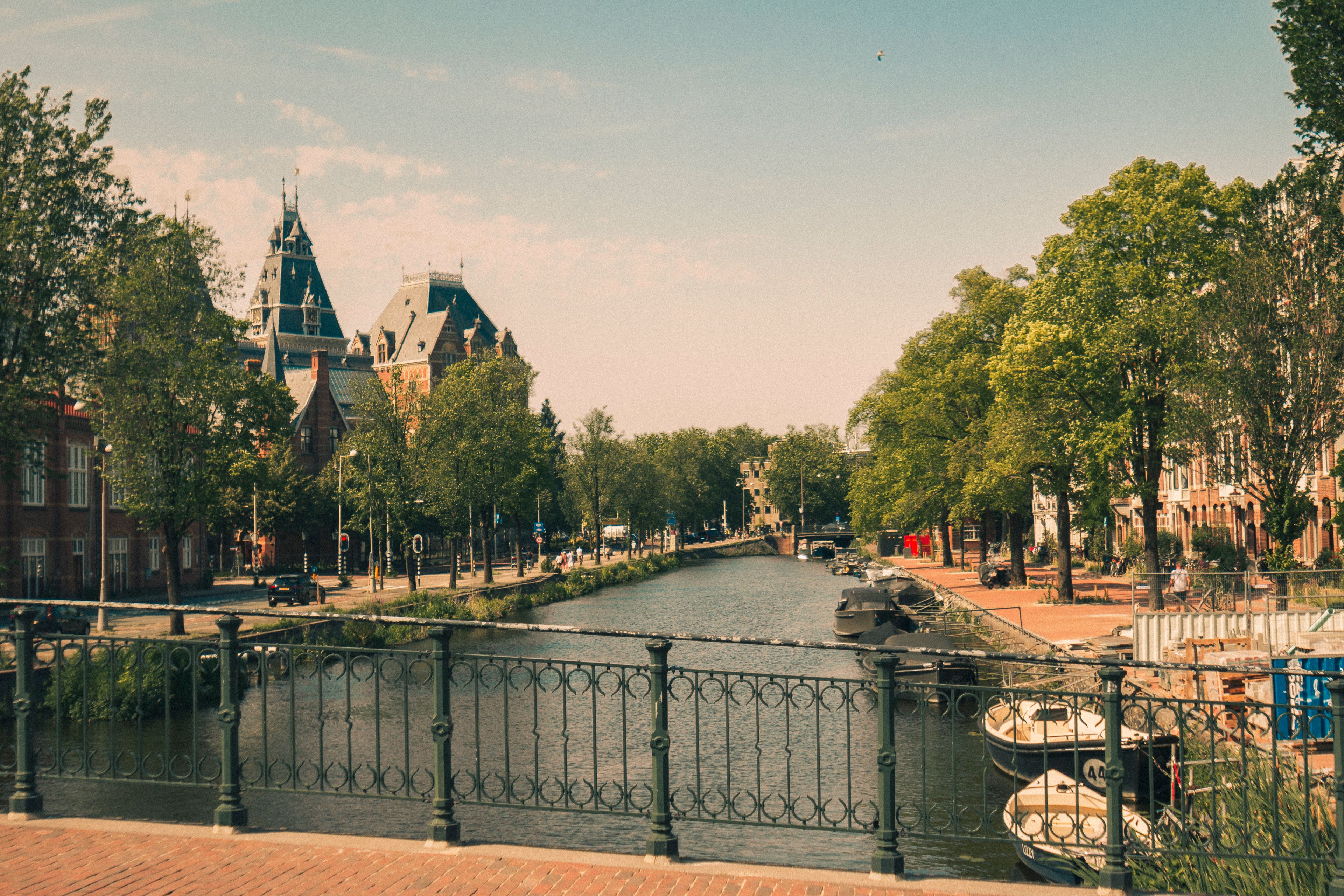
Day 3: Old center, a canal cruise & one neighborhood market (east side + water)
Day three picks up the half of Amsterdam this plan hasn't touched — the old center east of Dam Square — plus the one boat ride that's genuinely worth doing.
Morning — the historic center, fast and free. From your base, walk to Dam Square, duck into the quiet Begijnhof courtyard, pass the floating flower market (Bloemenmarkt) on the Singel, and wander toward Spui. You can see the Red Light District by daylight on the way through — it's most comfortable in the morning, when it reads as ordinary canal lanes rather than a stag-do crush (DutchReview). Skip the overpriced bars and "museums" jammed along it.
Midday — a canal cruise (the one boat ride to splurge on). This is the rare touristy thing that earns its fare, if you book the right one. A standard 60-minute cruise runs about €15–25 for the big covered glass-roof boats and €25–40 for a small open boat (KINboat — Are Amsterdam canal cruises worth it?). Spend the extra and take a small boat: 6–15 people with a live guide, individual seating and unobstructed views, versus 50–150 passengers and recorded commentary on the giant boats (KINboat — How to choose). Book the small ones ahead — the ticket kiosks along the water mostly sell the big boats only (FullSuitcase).
Afternoon — De Pijp & the Albert Cuyp Market. If you didn't get there on Day 2, spend the afternoon in De Pijp: the Albert Cuyp Market is the Netherlands' largest open-air market, 260-plus stalls, open Monday–Saturday 9am–6pm, and a perfect grazing lunch (GetYourGuide — De Pijp). The Heineken Experience is right here too — fine for a beer-loving group, with a worthwhile rooftop view for an extra fee, but it's a branded attraction, not a must (Budget Your Trip — Heineken Experience).
Evening. Last canal-side dinner, ideally back in the Jordaan or the Nine Streets near your base.
Worth it vs tourist tax: the calls that save your budget
Three days means choosing well. Here's where the mid-range money should and shouldn't go.
Timed-book ahead, no exceptions:
- Anne Frank House. Online-only, timed-entry, no door sales — and tickets are released all at once every Tuesday at 10am Amsterdam time for the date exactly six weeks later (Anne Frank House — Tickets). They go in minutes in peak months, so set a calendar reminder, be logged in, and pounce. There's also a small same-day release for the flexible (Anne Frank House — Tickets). This is the single most important booking of the trip.
- Van Gogh Museum and Rijksmuseum. Both require timed online tickets; both regularly sell out on weekends and in the April–October stretch (Van Gogh Museum — FAQ; Rijksmuseum). Book these a week or two out, not at the door.
Worth the fare: a small-boat canal cruise — the one boat ride that actually shows you the city, as long as you skip the cattle-class glass boats (KINboat).
Skip, or treat as optional:
- Damrak. The strip from Centraal to Dam is "where you will find some of the worst restaurants in town," plus gimmick "museums" (sex, torture) and cheese shops locals avoid (Amsterdam Sights — Avoid Damrak). Walk it to get oriented; don't eat or shop there. Any place flashing a "tourist menu" is a tell (Amsterdam Sights — Avoid Damrak).
- The Red Light District after dark, as a "sight." Pickpocket-prone and full of overpriced bars and shows; see it by day instead (DutchReview).
- The "I amsterdam City Card" — for this itinerary specifically. It bundles 70+ museums plus public transport and one free canal cruise (Amsterdam Card — Prices 2026). But here's the catch that sinks it for a classic 3-day trip: since 2022 it covers neither the Van Gogh Museum nor the Anne Frank House (Happy to Wander — I amsterdam City Card review) — the exact two things you came for. It pays off only if you'll genuinely cram 3-4+ museums a day and ride transit constantly (Happy to Wander). For a walkable plan built around two excluded headliners, buy individual tickets and skip the card.
Your 3 days in Amsterdam itinerary at a glance
| Day | Area | Morning | Afternoon | Evening | Pre-book? | Walking between stops |
|---|---|---|---|---|---|---|
| Day 1 | Canal Belt & Jordaan (west) | Canal-ring loop + Nine Streets | Jordaan lunch → Anne Frank House | Westerkerk / Jordaan brown café | Anne Frank: essential (6 wks ahead) | All on foot (5–10 min hops) |
| Day 2 | Museumplein (south) | Rijksmuseum at opening | Vondelpark breather → Van Gogh Museum | Leidseplein or De Pijp dinner | Both museums: yes (1–2 wks ahead) | 15–20 min walk from base; trams 2/3/5/12 optional |
| Day 3 | Old center + water (east) | Dam, Begijnhof, flower market, RLD by day | Small-boat canal cruise | Jordaan / Nine Streets dinner | Small-boat cruise: book ahead | On foot; cruise from a central dock |
Practical notes: tickets, getting around, when to book
Getting around — mostly your feet. Amsterdam's center is compact and made for walking; major landmarks sit 10–15 minutes apart on foot (Tickets-Amsterdam). Base in the Canal Belt and you'll rarely need transit — which is the whole point of the route above. When you do, the GVB trams, buses and metro cover the city, and since 2022 you can just tap a contactless Visa/Mastercard at the validators (about €3.40 per ride), no special card needed (Public Transport Guide — Amsterdam). If you'll ride a lot in one day, a GVB day pass works out cheaper (Public Transport Guide). Renting a bike is the local way but is genuinely intimidating for first-timers in three days — walking is the lower-stress choice.
Tickets, in priority order. Anne Frank House first (six weeks out, Tuesday 10am), then Rijksmuseum and Van Gogh (a week or two out), then your small-boat cruise. Everything else you can decide on the day.
When to book the room. You're a plan-ahead traveler, not a same-day booker, so you have time on your side — but central Canal Belt and Nine Streets rooms are the first to go in peak season. Booking a few weeks out at a fair rate beats scrambling for a leftover room two tram stops from the route. Travelling without wanting to touch transit at all? our car-free Amsterdam where-to-stay guide leans into exactly that.
FAQ
Is 3 days enough for Amsterdam? Yes, comfortably, for a first trip. Three days covers the canal ring and Jordaan, the two headline museums, the old center and a canal cruise without rushing — as long as you group each day by area so you walk instead of commute, and pre-book the Anne Frank House and the museums. A fourth day lets you add a market morning or a day trip; it isn't essential.
Where should I stay for a 3-day Amsterdam itinerary? The Canal Belt (Grachtengordel), ideally the Nine Streets pocket. It sits between everything on this route — a short walk west to the Jordaan and Anne Frank House, east to the old center, and south to Museumplein — so every day starts on foot. Expect to pay a central premium, and remember the 12.5% tourist tax is usually added on top of the advertised rate.
Do I really need to book the Anne Frank House and Van Gogh Museum in advance? Yes. Both are timed-entry and online-only, with no walk-up tickets, and both sell out — the Anne Frank House often in minutes. Anne Frank tickets release every Tuesday at 10am Amsterdam time for the date six weeks later; book the museums one to two weeks ahead. This is the part of an Amsterdam trip you cannot improvise.
Is the I amsterdam City Card worth it for this itinerary? Usually not for a classic 3-day trip. It excludes both the Van Gogh Museum and the Anne Frank House — the two things most people prioritize — so it only pays off if you'll visit several other museums a day and use transport heavily. For a walkable plan built around those two headliners, individual tickets are cheaper.
Is the Amsterdam canal cruise a tourist trap? The big glass-roof boats can feel like one; a small open boat with a live guide is genuinely worth it. Pay a little more for the small-boat version (6–15 people), and book it ahead, since the kiosks by the water mostly sell the large boats.
Ready to lock it in?
Pick your dates, book the Anne Frank House the moment its six-week window opens, then secure a central Canal Belt or Nine Streets base so all three days start on foot. Use the map below to see what's actually free for your nights and compare central mid-range rooms before they fill.
Planning the bigger picture? Our mid-range Amsterdam travel guide ties the neighborhoods, sights and budget together.
Sources
- Anne Frank House — Tickets (online-only, timed entry, Tuesday six-week release): annefrank.org
- Anne Frank House — Practical information (address, Jordaan/Prinsengracht location, tram closure): annefrank.org
- Rijksmuseum — Visit (opening hours, required start-time booking): rijksmuseum.nl
- Van Gogh Museum — Address and opening hours: vangoghmuseum.nl
- Van Gogh Museum — Frequently asked questions (timed entry, grace window, sell-outs): vangoghmuseum.nl
- GetYourGuide — Best neighborhoods in Amsterdam (Canal Belt, Nine Streets, Jordaan): getyourguide.com
- GetYourGuide — Things to do in De Pijp (Albert Cuyp Market, character): getyourguide.com
- Headout — Where to stay in Amsterdam (neighborhood pricing): headout.com
- The Hotel Guru — Best hotels in Amsterdam's Canal Belt: thehotelguru.com
- KINboat — Are Amsterdam canal cruises worth it? (prices): kinboat.com
- KINboat — How to choose the best canal cruise (small vs big boat): kinboat.com
- FullSuitcase — Amsterdam canal cruise tips (book small boats ahead): fullsuitcase.com
- Amsterdam Sights — Avoid Damrak (tourist-trap dining/attractions): amsterdamsights.com
- DutchReview — Red Light District guide (see it by day, pickpockets): dutchreview.com
- Budget Your Trip — Is the Heineken Experience worth visiting?: budgetyourtrip.com
- Amsterdam Card — I amsterdam City Card prices 2026: amsterdamcard.org
- Happy to Wander — I amsterdam City Card review (Van Gogh & Anne Frank excluded): happytowander.com
- Public Transport Guide — Amsterdam transport (GVB, contactless, day pass): publictransportguide.com
- Tickets-Amsterdam — Anne Frank House location / getting there (compact, walkable): tickets-amsterdam.com
- Tickets-Amsterdam — Van Gogh Museum location (trams to Museumplein): tickets-amsterdam.com
- Amsterdam Tourism — Trip cost / budget breakdown (12.5% tourist tax): amsterdamtourism.org
- Machu Picchu — Amsterdam Budget Guide 2026 (mid-range nightly bands): machupicchu.org