Barcelona on a Budget: Where to Stay for Strong Value (Without Going Hostel)
- Barcelona
- Spain
- Budget Travel
- Where to Stay
- Value
Where to stay in Barcelona on a budget without a hostel: the best-value neighborhoods, their honest trade-offs, and the levers that actually cut the bill.
Figuring out where to stay in Barcelona on a budget isn't about resigning yourself to a bunk in a 12-bed dorm. It's a quieter trade: give up the postcard address on La Rambla, and the same money buys a private, comfortable 3-4 star room in a neighborhood locals actually live in. The catch is that "cheaper" and "too far out" sit closer together here than people think — and the difference between a smart-value base and a tiring one comes down to which cheaper neighborhood you pick, and when you go.
The short answer for most value-hunters: base yourself in Poble Sec or Sant Antoni. Both sit a 15-minute walk from the old town, both run well below Gothic Quarter prices, and both have the tapas-and-market street life that makes a budget trip feel rich rather than compromised. Poble Sec edges it for sheer value plus Montjuïc on the doorstep; Sant Antoni for being a touch more central. The rest of this guide works out which value neighborhood fits your trip — plus the levers that move a Barcelona bill far more than your hotel star rating does.
First, the one rule: how far out is too far?
Barcelona's sights are spread wider than Rome's or Lisbon's, but its metro is excellent — frequent, cheap, and threaded right under the tourist core. So you don't need to sleep in the Gothic Quarter; you need to sleep within a 10-15 minute walk of the center, or one or two short metro stops from it. Cross that line and the savings get eaten by taxis, long hauls home after dinner, and a base that never feels convenient.
The expensive zones are predictable: the Gothic Quarter (Barri Gòtic), El Born, and the prime stretch of Eixample around Passeig de Gràcia, where peak-summer three-stars routinely run €180-280 a night for a smaller, plainer room than the same euros buy two neighborhoods over (Machu Picchu — Barcelona Budget Guide 2026).
Step just outside that ring instead. For reference, a mid-range 3-star in Barcelona averages roughly €90-170 a night, dropping to €90-150 in winter and shoulder months (Budget Your Trip — Barcelona hotel prices). Throughout, bands are: $ = lower mid-range, $$ = typical mid-range, $$$ = top of mid-range / boutique — all for a private double, not a dorm.
For the wider trip, see our full mid-range Barcelona travel guide. Now, where the value actually lives.
Poble Sec — the best value without sacrificing too much
If one neighborhood threads the needle between cheap and central, it's Poble Sec. It sits on the lower slopes of Montjuïc, immediately south of El Raval, and it's roughly a 15-minute walk to the city center (Hotel Brummell) — close enough to walk in by day and metro home after dinner (Poble Sec, Paral·lel, and Plaça d'Espanya stations all serve it). It's cheaper for a simple reason: a compact district with relatively few hotels, it never priced itself up the way the old town did (Santorini Dave — Where to Stay in Barcelona).
For the saving you get one of the city's best eating strips — Carrer de Blai, wall-to-wall pintxos bars where a skewer runs a euro or two — with Montjuïc's gardens, the Joan Miró Foundation, and the Magic Fountain a stroll uphill. Young, arty, genuinely local.
Who it suits: value-first travelers who still want atmosphere and a great cheap dinner downstairs; anyone who'll spend a day on Montjuïc. The trade-off: the hotel selection is thin, so the best-value rooms book out early — and a few streets blur into the rougher edge of El Raval, so check where a cheap listing sits. Metro/walkability: Poble Sec and Paral·lel (Line 3 / Line 2); ~15 minutes on foot to the Gothic Quarter.
Where the mid-range money goes:
- $$ — Mid-range: Hotel Brummell is the standout — a 20-room boutique in a restored 1870 building with a rooftop plunge pool and free yoga, design flair at a fair price (Hotel Brummell; Michelin Guide — Hotel Brummell).
- $ — Lower mid-range: Hotel Paral·lel, right on the Paral·lel metro, is the dependable no-frills pick — a clean private room and a short ride everywhere (Hotel Paral·lel).
Our best-value pick for most travelers: Hotel Brummell in Poble Sec — boutique character, a rooftop dip, a 15-minute walk to the old town, at a rate that undercuts comparable rooms in the center. The "comfortable, central-ish, not overpriced" combo this guide is built around.
Sant Antoni — central-ish, rising, and still fair-priced
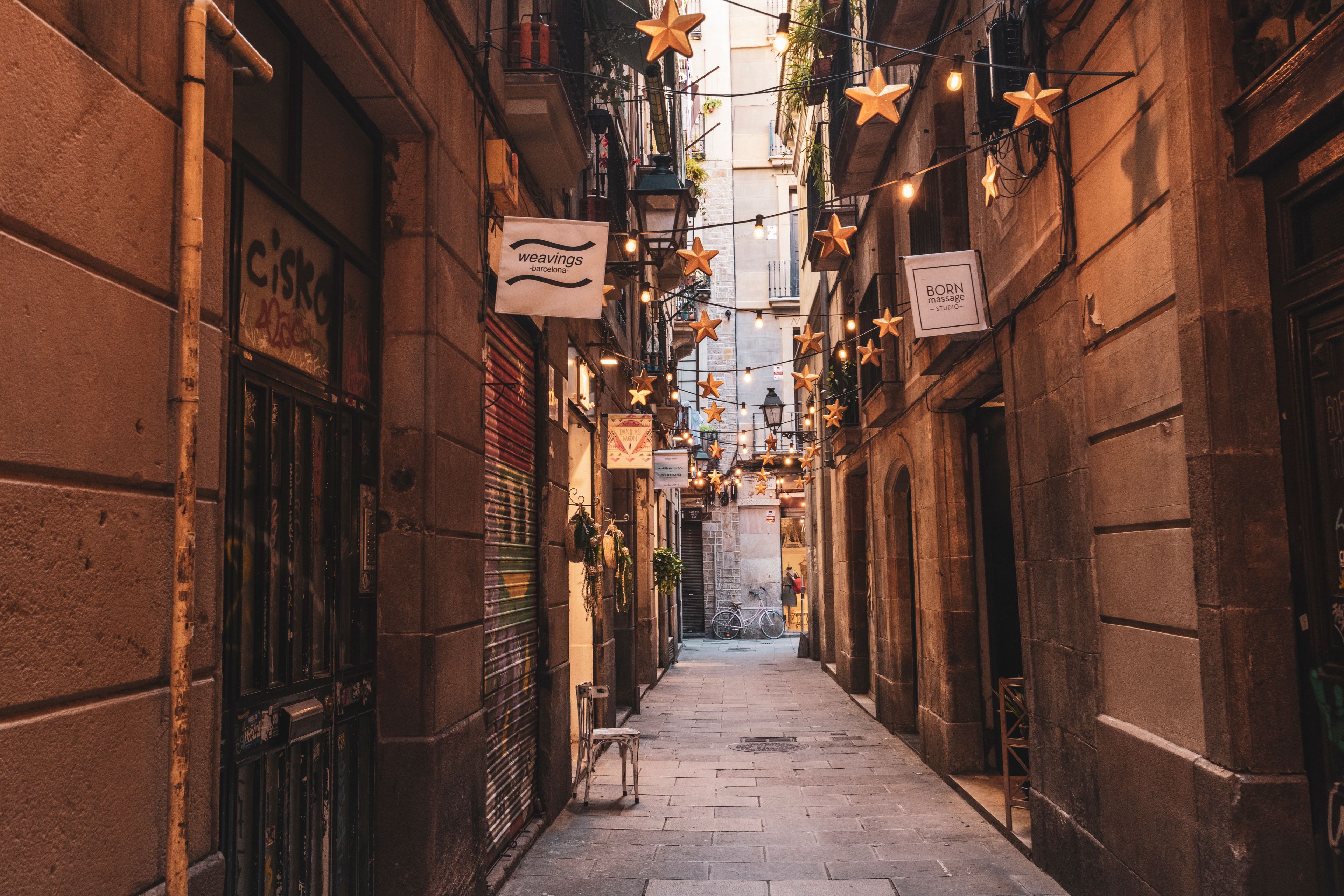
Sant Antoni is the value pick if you want to be that bit closer in. The southwest corner of Eixample, it's a 15-minute walk to La Rambla and Plaça de Catalunya (Following My Compass — Barcelona neighborhoods) and sits on Metro Line 2, so the whole city is a short hop. It runs cheaper than the core because, despite that proximity, it stayed residential and under-the-radar far longer than its neighbors (Go Ask A Local — Where to Stay in Barcelona).
That's changing, and that's the appeal. The restored Sant Antoni Market made the area one of the city's best brunch-and-tapas enclaves, and the Sunday book-and-coin market still wraps the building from 8:30am to 2:30pm (Barcelona City Council — Sant Antoni Sunday Market). You're still ahead of the price curve, but not for many more years.
Who it suits: foodies and first-timers who want central-and-cheap, café culture, and a real neighborhood feel. The trade-off: no marquee sight on the doorstep, and the buzzy bar scene means some streets get loud on weekends (Following My Compass — Barcelona neighborhoods) — book off the main drags if you're a light sleeper. Metro/walkability: Sant Antoni (Line 2); ~15-minute flat walk to the center.
Where the mid-range money goes:
- $$ — Mid-range: Hotel Lugano Barcelona, near the Paral·lel/Plaça d'Espanya edge, is the area's reliable value-with-comfort pick (Tripadvisor — Hotel Lugano Barcelona).
- $$$ — Boutique / top mid-range: Hotel Casa Elliot, a stylish 38-room spot under ten minutes' walk from Plaça de Catalunya, for travelers stretching the band for design and a near-central address (myboutiquehotel — Sant Antoni boutique hotels).
Deciding between the value picks and a more classic first-timer base? See our first-timer's where-to-stay guide for Barcelona.
Gràcia — local, leafy, and worth the metro hop
Gràcia is the move if you'll trade a little convenience for the most charming local life on this list. A former independent town swallowed by the city, it's a warren of narrow lanes opening onto plazas full of people nursing a vermut — "Barcelona but not touristy." Hotels here are cheaper than the old center precisely because of the distance: it sits north of the main Eixample, a metro ride (Line 3, Fontana or Diagonal) or a 25-30 minute walk from the central sights (Santorini Dave — Where to Stay in Barcelona; Go Ask A Local — Where to Stay in Barcelona).
The geography hands you one consolation: Gaudí's Eixample is on the doorstep. Casa Batlló and La Pedrera are an easy walk down Passeig de Gràcia, Park Güell just uphill.
Who it suits: repeat visitors and slow travelers who want to live somewhere for a few days, couples, and anyone happy with a short ride to the headline sights. The trade-off: the farthest-out value pick — no major monument inside the neighborhood, and you'll lean on the metro daily (Go Ask A Local — Where to Stay in Barcelona). Metro/walkability: Fontana / Diagonal (Line 3); ~25-30 minutes on foot to the center, or a few quick metro stops.
Where the mid-range money goes:
- $$ — Mid-range: Hotel Catalonia Gràcia sits on the Gràcia–Eixample border with two metro stops within a couple of blocks — a genuine value standout for the location (Go Ask A Local — Where to Stay in Barcelona).
- $ — Lower mid-range: Hotel BESTPRICE Gràcia trades size for value (small but new rooms), and Aparthotel Silver by Fontana metro adds a kitchenette for self-caterers cutting food costs (Go Ask A Local — Where to Stay in Barcelona).
Poblenou — beach-value, if you'll commute
Poblenou is Barcelona's value beach play. A former industrial district reinvented by artists, designers, and tech offices, it puts you minutes from the sand at Bogatell — quieter and more local than tourist-clogged Barceloneta — with street art, converted-factory studios, and a rambla of its own. It's cheaper because it's farther out and skews toward modern chain and design hotels rather than scarce old-town boutiques (Santorini Dave — Where to Stay in Barcelona).
The distance is real: this is the farthest base here from the historic sights. The saving grace is the metro — Line 4 (yellow) runs through it, and Llacuna to Jaume I in the Gothic Quarter is about a 7-minute ride (Rome2Rio — Poblenou to Gothic Quarter). The honest snag: some Poblenou hotels sit a "stiff walk" from the nearest station, so pin the metro distance before you book (Santorini Dave — Where to Stay in Barcelona).
Who it suits: beach-first travelers, design lovers, and anyone fine trading a daily metro ride for sand, space, and lower rates. The trade-off: farthest from the old town, and a few blocks still feel half-industrial — location-check each listing for both the beach and the metro (Santorini Dave — Where to Stay in Barcelona). Metro/walkability: Llacuna / Poblenou (Line 4); not walkable to the center — it's a metro commute (~7-11 minutes to the Gothic Quarter).
Where the mid-range money goes:
- $$ — Mid-range: ibis Styles Barcelona City Bogatell is the dependable value pick — outdoor pool, generous breakfast, a 3-minute walk to Bogatell metro on Line 4 (Tripadvisor — ibis Styles Barcelona City Bogatell).
- $$$ — Boutique / top mid-range: Hotel SB Icaria, a 4-star by Port Olímpic five minutes' walk from the beach with a pool and sauna — top-of-band, but cheaper than equivalent comfort in the center (SB Hotels — Icaria).
El Raval — cheapest and central, with honest caveats
El Raval is the wildcard: the one place that's both genuinely central and genuinely cheap. Just west of La Rambla, walkable to everything, it holds "some of the best-value accommodation in central Barcelona" — a bohemian, ethnically mixed, gentrifying-but-still-gritty quarter with the MACBA contemporary-art museum, indie boutiques, and a heavy concentration of budget rooms (Santorini Dave — Where to Stay in Barcelona).
Now the honest part, because it matters here more than anywhere else on this list. El Raval has long carried some of the city's higher petty-crime rates, varying sharply by street and hour. The southern end around Carrer d'En Robador has visible street-level drug and sex trade; the edges nearer Drassanes and Plaça Universitat are calmer (Nomada — El Raval Barcelona). It's fine by day and on main, well-lit streets; after about 11pm foot traffic thins, isolated alleys are best avoided, and phone-snatching is a real risk (Studentfy — Is Raval Safe?). This isn't "avoid El Raval" — it's "book toward its calmer northern and eastern edges, keep your phone away at night, and you'll be fine."
Who it suits: budget travelers who want maximum centrality for the lowest price, are comfortable in a livelier quarter, and will be sensible at night. The trade-off: the safety variability above, plus a lot of poor-quality cheap rooms to sort through — pick a vetted property, not the rock-bottom listing (Santorini Dave — Where to Stay in Barcelona). Metro/walkability: Liceu / Universitat / Drassanes (Lines 1, 2, 3); fully walkable to the old town.
Where the mid-range money goes:
- $$ — Mid-range: Eco Boutique Hostal Grau, a family-run, LEED-certified small hotel within 200 metres of La Rambla — private, stylish rooms (not a dorm) on the calmer northern edge near Universitat (Hostal Grau; myboutiquehotel — Eco Boutique Hostal Grau).
- $$$ — Boutique / top mid-range: Casa Camper, the area's design splurge — 25 rooms with separate living spaces and free round-the-clock snacks, from the Camper shoe family (Casa Camper).
The levers that actually move a Barcelona bill
Your neighborhood sets the floor on your room rate. These four levers move the total more than swapping one mid-range hotel for another — the first dwarfs the rest.
1. When you go (the biggest lever by far). The cheapest stretch is November to February (excluding the Christmas/New Year spike), when flights and hotels drop hard after peak season (Klook — Best Time to Visit Barcelona). The shoulder months — March-April and September-October — are the sweet spot: pleasant weather, thinner crowds, prices well below summer (GetYourGuide — Best Time to Visit Barcelona). Avoid August: hottest, most crowded, peak prices, many local spots shut (EuroCheapo — Barcelona: When to go). The same Poble Sec room can swing from ~€90-150 in winter to ~€180+ in summer (Machu Picchu — Barcelona Budget Guide 2026). Shift your dates before you shrink your hotel.
2. Lunch on the menú del día. Barcelona's set lunch is the best value in Spanish dining: three courses with bread and usually a drink, typically €10-15 (Devour Tours — Lunch in Barcelona; Creative Travel Guide — Barcelona Prices). Eat your big meal at midday for a fraction of the à la carte dinner price — an easy €15-25 a day saved per person.
3. The transit card. Skip single tickets. Within the city (Zone 1), the T-casual — a 10-journey card for about €13 (TMB — Barcelona fares) — is the locals' choice, roughly €1.30 a ride across metro, bus, and tram. For unlimited rides plus the airport metro, the Hola Barcelona card runs about €18.70 (48h), €27.30 (72h), or €35.60 (96h), including a return airport trip (TMB — Hola Barcelona Travel Card). For most short stays the T-casual wins; do the math against your ride count.
4. Budget for the tourist tax (it doubled). As of April 2026, Catalonia's per-night tourist tax in Barcelona roughly doubled. For the 3-4 star band you'll book, expect roughly €6-8.40 per person, per night on top of your room rate (Idealista — Barcelona's tourist tax is now double; Catalan News — 2026 price changes). For two people over four nights that's ~€48-67 you won't see in the headline rate — and the municipal share keeps ticking up annually toward 2029, so confirm the exact figure at booking.
Where to stay in Barcelona on a budget: neighborhoods at a glance
| Neighborhood | Why it's cheaper | The trade-off | To the center | Rough 3-4★ nightly band |
|---|---|---|---|---|
| Poble Sec | Few hotels, never priced up; Montjuïc-side | Thin supply books early; some edges blur into El Raval | ~15-min walk (Lines 2/3) | $–$$ |
| Sant Antoni | Stayed residential despite being close in | No marquee sight; weekend bar noise | ~15-min walk (Line 2) | $$ |
| Gràcia | Farther out = lower rates; local town feel | Farthest walkable pick; metro-dependent | ~25-30 min / metro (Line 3) | $–$$ |
| Poblenou | Out by the beach; modern/chain hotels | Not walkable to old town; some hotels far from metro | ~7-11 min by metro (Line 4) | $$–$$$ |
| El Raval | Central but gritty; glut of budget rooms | Real night-time/safety variability; quality varies | Walkable (Lines 1/2/3) | $–$$ |
How to choose: the two picks that matter
Strip it down and most value-hunters are choosing between two:
- Best value without sacrificing too much — Poble Sec. Cheap, atmospheric, a 15-minute walk into the old town, Montjuïc on the doorstep. Sant Antoni is the near-tie if you want to be a touch more central; Gràcia if you'll trade a metro ride for the most local feel.
- Cheapest-that-still-works — El Raval. The lowest prices inside the central core, if you book toward its calmer northern/eastern edges and stay phone-smart at night. Poblenou is the alternative if you'd rather spend the saving on the beach than the center.
The order of operations is the same either way: lock your dates in a cheaper month first, pick the value neighborhood second, chase the room last. Do that and Barcelona is a remarkably affordable city — no dorm required. Browsing for a future trip rather than booking today? Compare value stays across Barcelona on Expedia → — its longer booking window suits travelers who'll lock in a few weeks out.
FAQ
What's the cheapest time to visit Barcelona? November to February (skip the Christmas–New Year peak) is cheapest; March-April and September-October are the shoulder-season sweet spot with good weather and lower prices. Avoid August — hottest, priciest, most crowded, and many local businesses close (EuroCheapo — Barcelona: When to go).
Is El Raval safe to stay in? Manageable with judgment. It's fine by day and on busy main streets; the southern stretch around Carrer d'En Robador is the rough part, while the Drassanes and Plaça Universitat edges are calmer (Nomada — El Raval Barcelona). Book toward the calmer edges, keep your phone away on quiet streets after about 11pm, and you'll be fine.
Ready to plan?
Use the maps above to see what's free on your dates in each value area, lean toward the most central room your budget allows, and pencil in the tourist tax. For the full picture, see our mid-range Barcelona hotel guide and our 3-day Barcelona itinerary.
Sources
- Santorini Dave — Where to Stay in Barcelona (best neighborhoods): santorinidave.com
- Go Ask A Local — Where to Stay in Barcelona (a local's guide): goaskalocal.com
- Following My Compass — Best Neighborhoods to Stay in Barcelona 2026: followingmycompass.com
- Hotel Brummell — official site (Poble Sec, location and features): hotelbrummell.brummellprojects.com
- Michelin Guide — Hotel Brummell, Barcelona: guide.michelin.com
- Hotel Paral·lel — official site (Poble Sec): hotelparalel.com
- Tripadvisor — Hotel Lugano Barcelona: tripadvisor.com
- myboutiquehotel — Sant Antoni boutique hotels: myboutiquehotel.com
- Barcelona City Council — Sant Antoni Sunday Market: barcelona.cat
- Tripadvisor — ibis Styles Barcelona City Bogatell (Poblenou): tripadvisor.com
- SB Hotels — Hotel SB Icaria (Poblenou/Port Olímpic): sb-hotels.com
- Rome2Rio — Poblenou to Gothic Quarter travel time: rome2rio.com
- Hostal Grau — Eco Boutique Hostal Grau (El Raval): hostalgrau.com
- myboutiquehotel — Eco Boutique Hostal Grau: myboutiquehotel.com
- Casa Camper — official site (El Raval): casacamper.com
- Nomada — El Raval Barcelona: is it safe to visit or stay?: nomada.co
- Studentfy — Is Raval Safe? (2026): studentfy.com
- Klook — Best Time to Visit Barcelona: klook.com
- GetYourGuide — Best Time to Visit Barcelona: getyourguide.com
- EuroCheapo — Barcelona: When to go: eurocheapo.com
- Devour Tours — Lunch in Barcelona (menú del día): devourtours.com
- Creative Travel Guide — Barcelona Prices 2026: creativetravelguide.com
- TMB — Barcelona metro and bus fares (T-casual / Hola Barcelona): tmb.cat
- TMB — Hola Barcelona Travel Card: tmb.cat
- Catalan News — What prices are going up in 2026 (tourist tax, transport): catalannews.com
- Idealista — Barcelona's tourist tax is now double: idealista.com
- Budget Your Trip — Barcelona hotel prices: budgetyourtrip.com
- Machu Picchu — Barcelona Budget Guide 2026: machupicchu.org